
Bring your data
One model, a serial-number list and available documents.
- Check how source fields map to passport data.
- Identify duplicates, missing information and owners.

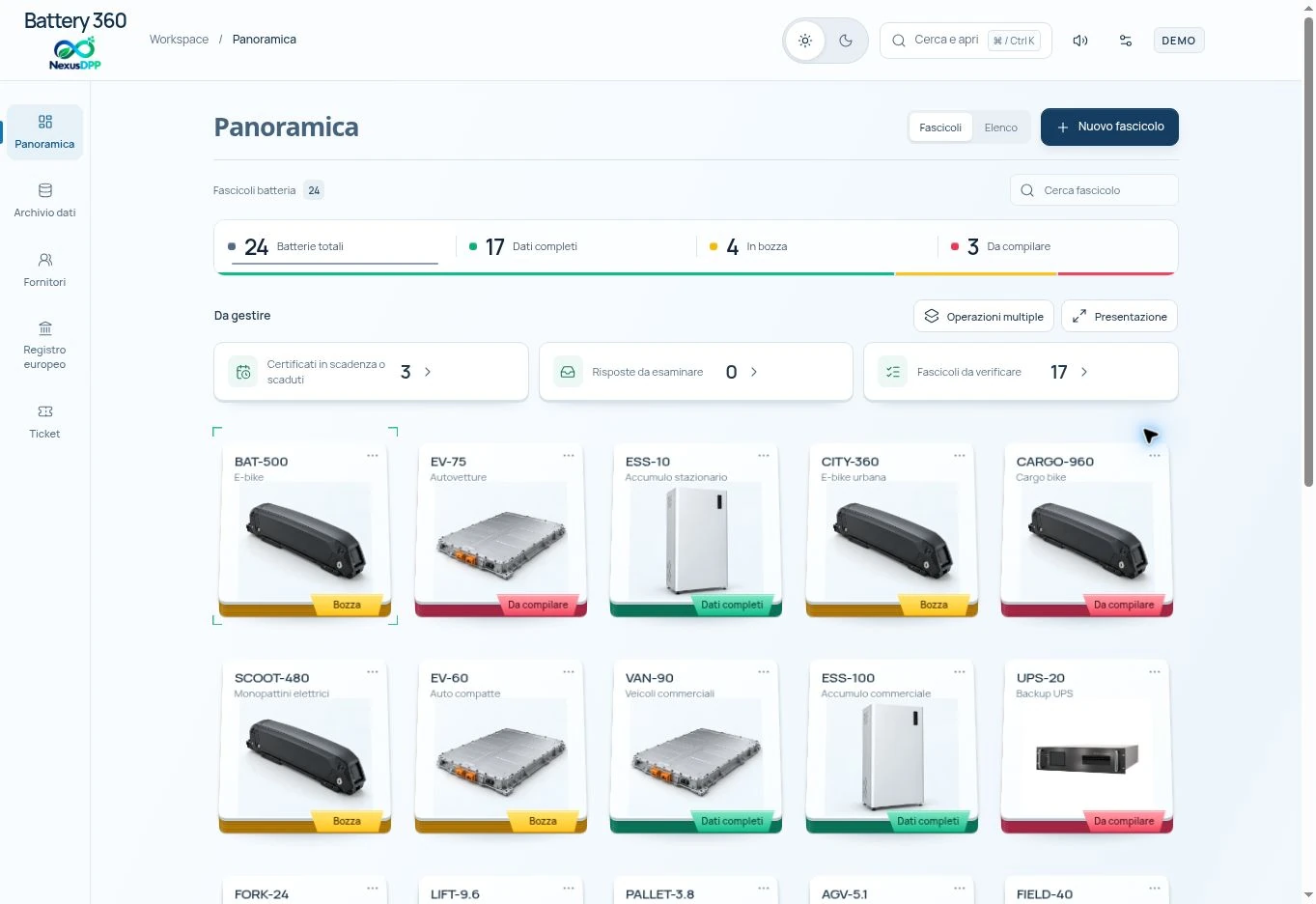
NexusDpp is the B2B software developed by NexusDpp S.r.l. for manufacturers, importers and brands organising Digital Product Passport data. It collects supplier information and documents, manages approvals and versions, and connects the passport to QR codes or NFC.
Platform evaluation
Agree these checks for the pilot using a sample of your own data. Each check should produce an observable result.
One model, a serial-number list and available documents.
One operator prepares the data; an authorised reviewer checks it.
Open a passport from its QR code and compare the intended views.
Simulate an update and check how information can be retrieved.
The demo illustrates the process. Integration availability, configuration and acceptance criteria are agreed for each project.
The platform sits between business systems, the supply chain and public access without forcing unnecessary duplication.
Guided entry, file imports, document acquisition and API integrations with ERP, MES and WMS.
Tasks, responsibilities, supplier requests, validation and approval in configurable sequences.
QR, NFC and digital links for public and authorised access.
Separation of public, restricted and confidential information.
Updates, recalls, maintenance, second life and end-of-life events.
Dashboards for completeness, deadlines, anomalies and DPP status.
NexusDpp can receive data and activation events from source systems while governing rules, identities, lifecycle and publication.
A company can start with guided workflows and progressively add document automation and API integrations.
Forms, roles and completeness checklists for a rapid start.
Extract and classify information from attachments for human review.
Synchronise data and events with source systems and business processes.
To choose DPP software, bring the same sample data to each provider and ask for verifiable results. Use these eight checks to record what you have read, seen in a demo or tested in a pilot.
NexusDpp method: a buyer’s working sheet with no rankings or pre-filled ratings. You enter the results; a successful demo does not certify regulatory compliance.
30 October 2026 edition · NexusDpp S.r.l.Record only evidence you have actually checked. If a test does not apply to your project, explain why in the notes.
Does the data model distinguish required, conditional and irrelevant fields for the category?
Evidence to request: Request a field → source → owner map with units, applicability reasons and the reference used. Missing information should remain identifiable.
How are missing documents, duplicates and supplier requests handled?
Evidence to request: Import a small sample with a duplicate and a missing field. Inspect the error report, correction request and link to the documentary source.
Who may prepare, approve and publish a DPP version?
Evidence to request: Use two separate roles. Attempt publication without permission and inspect the record of who approved which version and when.
Does the QR code keep opening the passport for the correct product?
Evidence to request: Scan two test identifiers and update one record. Check the link after the update and ask how migration works. A QR code alone does not prove the physical product is authentic.
Does the public view actually exclude restricted information?
Evidence to request: Compare anonymous and authorised roles, including API access and document links. Revoke a permission and record the result.
Can a change to a data field or product status be reconstructed?
Evidence to request: Update one sample field and simulate a status change. Check the previous value, actor, date, reason and published version.
Which data can be exchanged and retrieved independently of the interface?
Evidence to request: Request an agreed API or import example and a readable export including identifiers, versions and document references. Check how errors are reported.
What remains available after the contract ends and what does the price include?
Evidence to request: Request written scope for setup, volumes, integrations, support, updates, backups, recovery, portability and exit costs. Distinguish available, configurable and planned features.
Responses are processed in your browser and are not sent to NexusDpp by this tool. Download the CSV before closing or reloading the page: responses are not saved.
For batteries, ask separately who creates and updates the passport and who registers it in the EU Registry. The mandate, responsibilities and service scope should be explicit. Reference: European Commission Battery Passport FAQs, section 2.
A NexusDpp project identifies the products, required fields and people responsible for each input. The workflow includes document collection, requests for missing information and approval before publication. Missing data must be identified and requested from its source.
NexusDpp can use existing business data and adds evidence collection, approvals, version management and passport publication. Files, APIs, update frequency and responsibilities are agreed for the project according to the systems available.
NexusDpp supports public views and restricted access. Which information is published and who may access it depends on the product category and applicable rules. A pilot tests the permissions using separate roles.
A quotation depends on models and volumes, the quality of available data, supplier numbers, integrations and required services. Compare initial configuration, platform usage and ongoing operations separately when assessing proposals.
The NexusDpp sample Battery Passport is freely accessible and contains fictional data. It illustrates a public passport; a platform demo is a separate opportunity to explore the operational workflow and your project requirements.
For an initial assessment, we suggest one model, one supplier and a sample of identifiers with available technical documents. The project defines missing data, responsibilities, access and acceptance criteria before expanding to other products.
Developed by NexusDpp S.r.l.. To assess the workflow with your data, request a DPP software demo.
Volumes, available data, integrations and ongoing operations: define the scope before comparing quotations.